






The 7 Best AI Agents to Grow Your Business in 2026
By Hossamudin Hassan
AI agents are no longer just tools that answer messages or write quick social media posts. In 2026, a well-designed AI agent can capture a customer inquiry, retrieve information from your CRM, send an appropriate follow-up, create a task for your team, and escalate sensitive cases to a human at the right moment.
Is your team still copying customer information manually between WhatsApp, email, spreadsheets, and CRM tools? Are invoice follow-ups delayed because your finance team is overloaded? Are you losing leads because prospects do not receive a quick response?
This is where AI agents create real business value. Their purpose is not to replace your team. Their purpose is to remove repetitive operational work so your people can focus on judgment, relationships, creativity, and complex decisions.
In this practical guide, I will explain the seven most valuable types of AI agents for businesses, how to choose the right one, and which tools can help you build them in 2026.
Hossamudin Hassan’s principle: Let AI handle coordination, follow-up, and repetitive execution. Let your experts handle judgment, expertise, and decisions.
What Is an AI Agent?
An AI agent is a system that works toward a specific goal within defined rules, permissions, and workflows.
Unlike a traditional chatbot, which typically responds to one question at a time, an AI agent can plan a sequence of steps, use business tools, access approved data, take actions, monitor results, and escalate exceptions when needed.
For example, imagine a prospect fills in a “Request a Quote” form on your website.
A chatbot may help you draft a suitable reply. An AI sales agent, however, can:
- Read the form submission.
- Identify the prospect’s company type and needs.
- Ask qualification questions.
- Score the lead according to your criteria.
- Add the contact to your CRM.
- Send an initial response.
- Alert the appropriate salesperson if the opportunity is high priority.
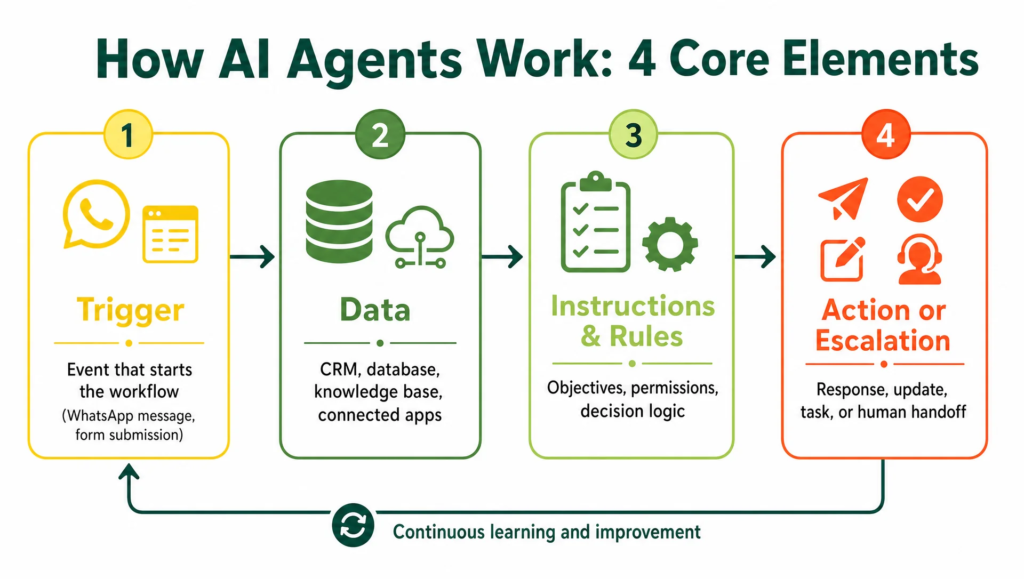
AI Chatbot vs. AI Agent
| Area | AI Chatbot | AI Agent |
|---|---|---|
| Primary role | Answers questions or generates content | Plans and executes steps toward a goal |
| Tool integrations | Usually limited | Can connect to CRM, email, forms, databases, and more |
| Sales example | Suggests a follow-up message | Qualifies leads, updates CRM records, and assigns sales tasks |
| Human oversight | Often required for each use | Built into the workflow for sensitive or exceptional cases |
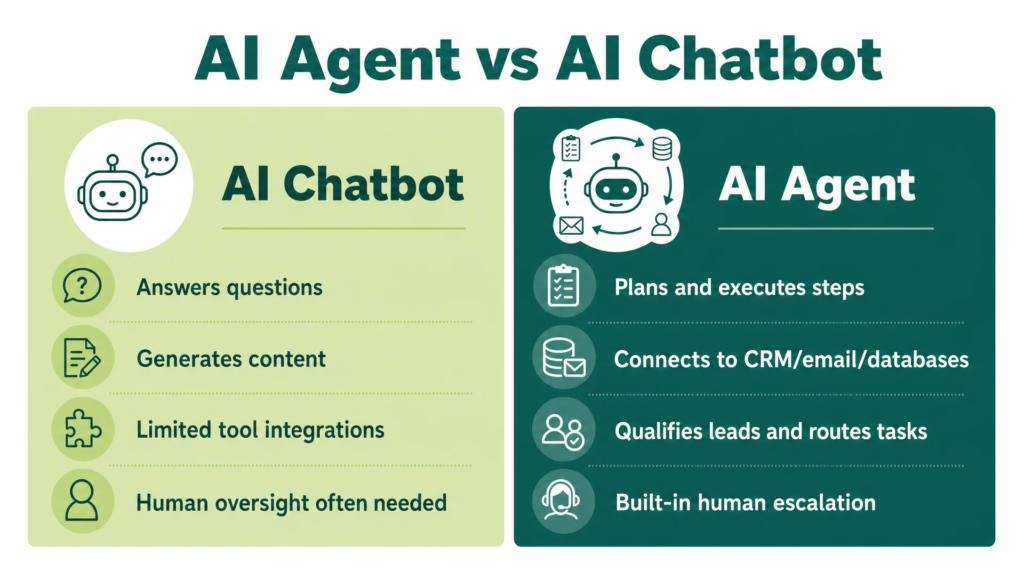
How AI Agents Work Inside a Business
Most AI agents consist of four core elements:
- A trigger: An event that starts the workflow, such as receiving a WhatsApp message or a new form submission.
- Data: Information from your CRM, database, documents, knowledge base, or connected applications.
- Instructions and rules: The agent’s objectives, permissions, restrictions, and decision logic.
- Action or escalation: A response, a database update, an assigned task, a notification, or a handoff to a human employee.
For example:
A customer sends a WhatsApp message → the agent identifies their intent → searches an approved knowledge base → provides a documented answer or transfers the conversation to the right team member.
However, AI agents should not independently make high-risk legal, financial, compliance, or credit decisions. They should not approve exceptional discounts, negotiate settlements, make employment decisions, or handle highly complex complaints without human oversight.
Why Businesses Need AI Agents in 2026
Business growth does not always require hiring more people. Many teams spend a large part of their day moving information between systems, following up with customers, reminding people about appointments, searching for policies, and asking who is responsible for the next step.
These tasks are necessary, but they are not always the best use of skilled human time.
AI agents can help businesses achieve:
- Faster response times: Customers should not have to wait until the next working day for an initial answer.
- Fewer operational errors: Automated workflows reduce manual copying, missed tasks, and inconsistent follow-up.
- A more consistent customer experience: Every customer receives a clear and organized journey.
- More productive teams: Employees can focus on sales, consulting, strategy, and complex problem-solving.
- Actionable business data: Instead of producing reports that nobody reads, agents create tasks, alerts, and follow-ups at the right time.
Whether you run an e-commerce store, a marketing agency, a real estate company, a clinic, a SaaS business, or a financial services firm, the best place to start is usually a process that is repetitive, clear, and time-consuming.
The 7 Best AI Agents for Business Growth
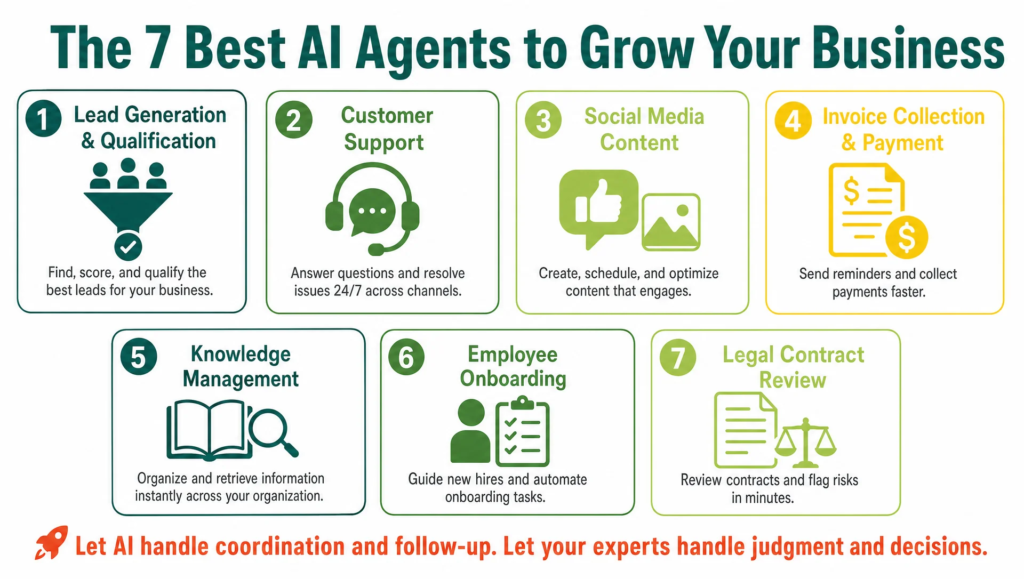
1. Lead Generation and Qualification AI Agent
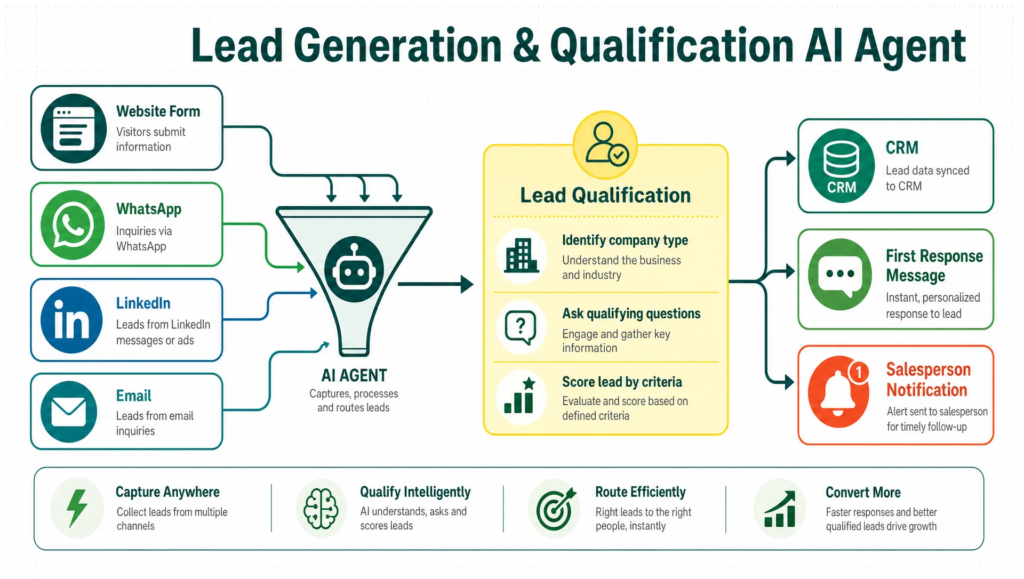
A lead generation agent is one of the most valuable AI agents for sales teams. It prevents good opportunities from getting lost across website forms, paid ads, LinkedIn messages, WhatsApp conversations, and email inboxes.
Its role is not to send random outreach messages. Its role is to identify, qualify, and route the right opportunities to your sales team.
A lead generation AI agent can:
- Capture leads from website forms, ads, LinkedIn, WhatsApp, or other channels.
- Collect initial information about the prospect’s needs and business type.
- Qualify the lead based on your criteria, such as industry, budget, company size, location, or buying timeframe.
- Add lead information to your CRM automatically.
- Send a relevant first response.
- Notify the correct salesperson when a qualified opportunity is ready for follow-up.
For example, a service company may receive 100 inquiries every month. Without a qualification system, the sales team may spend hours replying to low-fit prospects. An AI agent can ask initial questions about project scope, budget, and expected start date, then direct the highest-quality opportunities to the team.
Key metrics to track: First-response time, qualified-lead rate, meeting-booking rate, and lead-to-proposal conversion rate.
2. Customer Experience and Support AI Agent
A customer support AI agent should not be a machine that repeats, “Please contact us later.” A high-quality support agent uses an accurate and approved knowledge base to answer frequent questions quickly, while escalating sensitive or complicated cases to a human employee with a clear conversation summary.
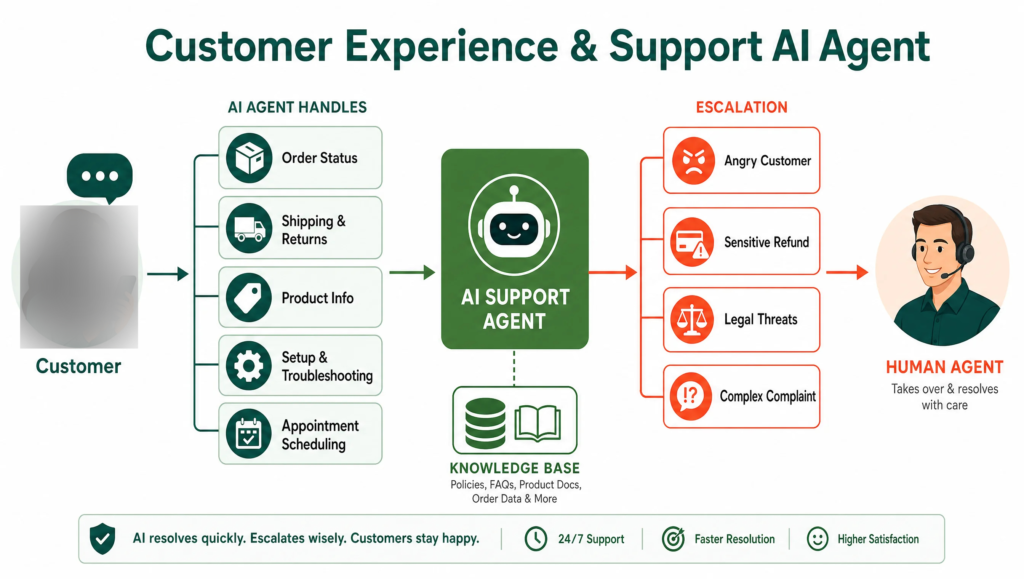
It can handle questions related to:
- Order status, shipping, returns, and refunds.
- Product information, pricing, and basic policies.
- Product setup and simple technical troubleshooting.
- Request categorization and routing to the appropriate department.
- Appointment scheduling and reminders.
The agent should stop and escalate when it detects an angry customer, a sensitive refund issue, personal or financial data, legal threats, or a complex complaint.
The quality of this agent depends not only on the AI model, but also on the quality of the knowledge base behind it. If your policies are outdated or scattered across random documents, the agent will not solve that problem automatically.
3. Social Media Content AI Agent
Asking AI to “write a post” does not mean you have built a content strategy.
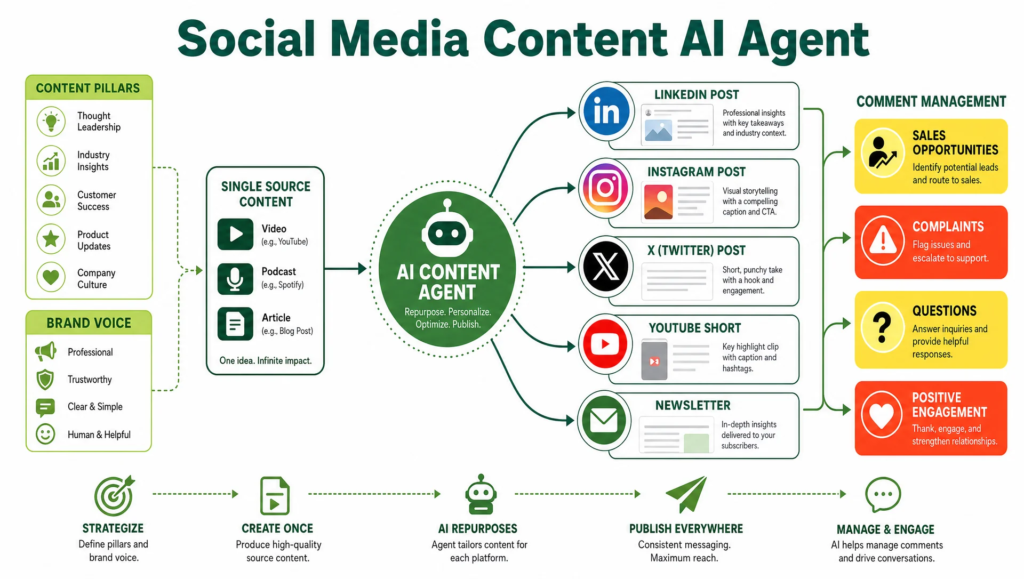
A real social media content agent understands your brand voice, target audience, current offers, content pillars, and the recurring questions your customers ask. It can transform a single video, podcast episode, webinar, or long-form article into multiple platform-specific posts.
A content AI agent can:
- Repurpose long-form content into LinkedIn posts, Instagram captions, X posts, newsletters, and video scripts.
- Generate content ideas based on customer questions and market trends.
- Organize a content calendar around campaigns and launches.
- Categorize incoming comments as sales opportunities, complaints, questions, or positive engagement.
- Draft responses for approval or trigger structured follow-up workflows.
One useful tool in this area is SureThing AI, which is well suited to what I call Vibe Automation: building fast, visual AI automations from practical business needs. I have used this type of workflow to automate Instagram comment handling and turn engagement into structured conversations or actions instead of relying on manual follow-up.
The important point is this: do not let automation become spam. Repetitive, irrelevant, or overly aggressive automated replies can damage customer trust and your brand reputation.
4. Invoice Collection and Payment Follow-Up AI Agent
Late payments are not always caused by irresponsible customers. Sometimes invoices are sent through the wrong channel, reminders are inconsistent, or the client has a simple question that nobody answered.
An invoice collection AI agent can manage follow-ups and coordination while leaving sensitive financial decisions to your finance team.
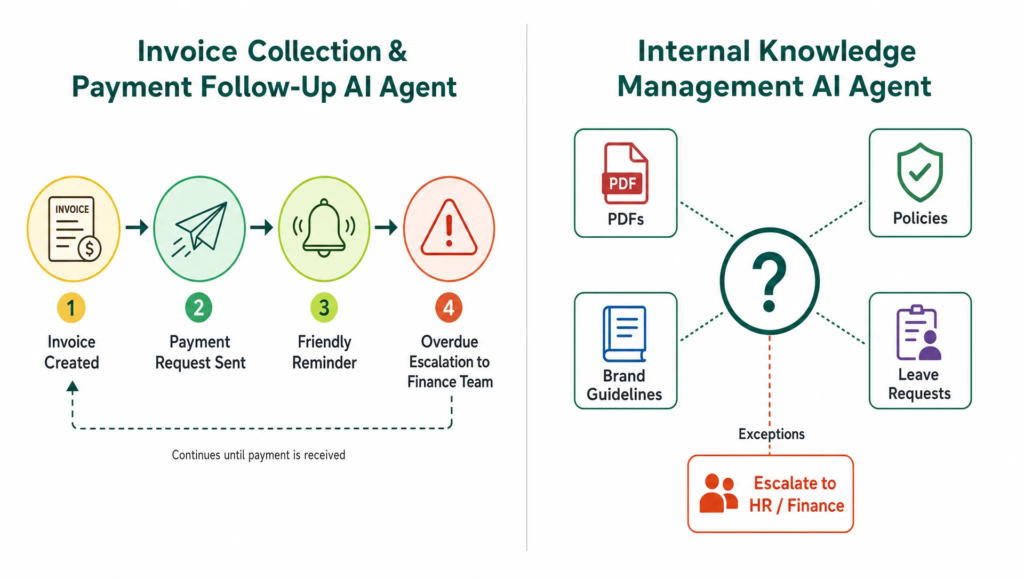
A typical workflow may look like this:
Invoice created → Payment request sent → Basic payment questions answered → Due date monitored → Friendly reminder sent → Overdue or disputed invoice escalated.
The agent can document every contact attempt, send reminders based on your company policy, update invoice status, and notify an account manager or finance specialist when human intervention is needed.
However, do not give the agent unrestricted authority to offer discounts, change payment terms, negotiate settlements, or make financial decisions without explicit approval.
5. Internal Policies and Knowledge Management AI Agent
As companies grow, knowledge becomes scattered across PDFs, email threads, Google Drive folders, internal messages, and outdated documents.
A new employee might ask:
- What is the expense policy?
- How do I request annual leave?
- Which approval is needed before buying software?
- Where can I find the company brand guidelines?
If different colleagues provide different answers, your organization creates confusion, delays, and unnecessary risk.
An internal knowledge agent answers questions only from approved sources, links users to the original policy or document, and tells them what action to take next. Just as importantly, it should be able to say:
“This situation requires approval from HR,” or “Please contact the finance team for this exception.”
To protect confidential information, use role-based access controls. An employee should not be able to retrieve payroll records, legal contracts, customer data, or executive information simply because they asked the AI agent.
6. Employee Onboarding AI Agent
A new employee’s first week shapes their long-term experience with the company. When onboarding is disorganized, productivity slows down and HR, IT, managers, and the new hire spend time chasing emails and incomplete tasks.
An employee onboarding agent organizes the entire journey from day one.
It can:
- Send a personalized onboarding checklist.
- Collect required forms and documents.
- Answer routine policy questions.
- Create account and equipment requests for IT.
- Schedule orientation meetings and training.
- Track incomplete tasks and send reminders.
- Alert the manager when an important action is overdue.
Instead of scattered emails and unclear ownership, each new employee gets a structured path with clear tasks, responsible people, and documented progress.
Official documents, sensitive access permissions, legal exceptions, and employment decisions should always remain under human review.
7. Legal Contract Review AI Agent
Can AI review a contract instead of a lawyer? No.
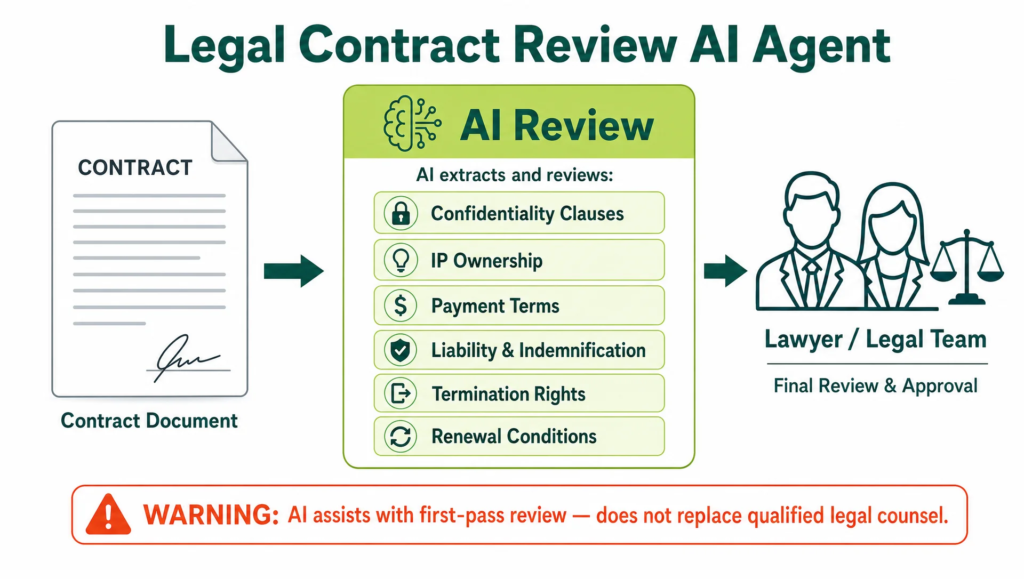
However, AI can be extremely useful for first-pass review, document organization, clause extraction, and issue spotting. A legal review AI agent can compare a contract against your company template and identify areas that deserve attention from a qualified legal professional.
It can help extract and review:
- Confidentiality clauses.
- Intellectual property ownership.
- Payment terms.
- Liability and indemnification provisions.
- Termination rights.
- Renewal conditions.
- Notice periods.
- Important dates, obligations, and renewal deadlines.
This can save legal teams time during the preparation and triage stages, but it does not provide binding legal advice.
Important legal note: AI can assist with organization and initial review, but it is not a replacement for a qualified lawyer—especially for high-value, regulated, cross-border, or sensitive contracts.
For initial clause extraction and contract summaries, I use tools such as Mahara AI’s AI Contract Reviewer. Before uploading any sensitive agreement, always review the platform’s privacy settings, data handling policies, and security controls.
Best Tools for Building AI Agents in 2026
There is no single best tool for every business. Your choice should depend on your team’s technical skills, the sensitivity of your data, your existing systems, and the complexity of the workflow you want to automate.
| Tool | Best For | Ease of Use | Customization |
|---|---|---|---|
| Zapier | Non-technical teams and fast automation | Easy | Medium |
| n8n | Flexible workflows and custom integrations | Medium | High |
| Albato | Connecting apps without extensive coding | Easy to medium | Medium |
| Moxo | Structured operations, client collaboration, documents, and approvals | Medium | High |
| CrewAI | Multi-agent systems and advanced technical workflows | Advanced | Very high |
| Perplexity | Research, verification, and knowledge gathering | Easy | Limited |
Zapier AI Agents can be a comfortable starting point for teams that need quick integrations with popular business applications.
n8n AI Agents are ideal when you need greater flexibility, custom logic, deeper integrations, and stronger control over your workflows.
Albato is another useful option for visual, no-code application integrations.
Moxo can be especially valuable for structured and regulated business processes involving clients, documents, approvals, teams, and external stakeholders. Examples include KYC workflows, investment requests, due diligence, client onboarding, and document collection.
The principle is simple: AI prepares, follows up, organizes, and verifies. Your team evaluates risk, makes compliance decisions, and provides the human expertise that customers and businesses still need.
How to Build Your First AI Agent
Do not start with a huge project such as, “I want an AI agent to run my company.”
Start with one real business problem that costs time, money, or missed opportunities.
- Choose a small, repetitive process. Start with lead qualification, invoice follow-up, policy questions, appointment reminders, or support ticket classification.
- Map the workflow first. Define what triggers the process, what data is needed, what action should happen, and when a human must intervene.
- Set clear permission boundaries. Decide exactly what the agent can do independently and what requires approval.
- Define success metrics. Measure time saved, response speed, conversion rate, support resolution time, or overdue invoice reduction.
- Start with a limited pilot. Test the agent with one department, workflow, or customer segment before expanding.
- Improve continuously. Review failed cases, update the knowledge base, refine prompts, and adjust escalation rules.
Successful AI business automation starts with process clarity, not with buying the newest tool.
If you are unsure where to begin—or if your business has many potential automation opportunities across sales, support, finance, and operations—you can book an AI Automation and AI Agents strategy session with Hossamudin Hassan.
Common Mistakes When Implementing AI Agents
- Buying a tool because everyone is talking about it: Start with the business process you want to improve, not the trend.
- Giving the agent too much authority: Human escalation should be part of the workflow design from day one.
- Using outdated information: AI cannot fix a disorganized or inaccurate knowledge base by itself.
- Measuring the number of automations instead of business impact: Focus on outcomes such as faster responses, better collections, improved conversions, and fewer errors.
- Ignoring privacy and security: Apply the principle of least privilege and understand where customer, employee, and contract data is stored and processed.
- Automating a broken process: Simplify and document the process before you automate it.
Learn AI Automation and AI Agents in Arabic
If you are asking questions such as:
- How do I learn automation?
- How do I build AI agents?
- How can I use n8n for automation?
- How do I connect AI with my business systems?
Start with the core concepts before getting overwhelmed by tools. Understand what a workflow is, what triggers an automation, what actions an agent can take, and when the system must stop and ask for human input.
You can watch my free Arabic training session, “Build Your Own AI Team,” here:
Watch the free AI Agents and Automation lecture
You can also explore:
- The free Artificial Intelligence course from Khabeer Online
- The ePreneurs YouTube channel
- The Arabic AI Automation Club
Which AI Agent Should You Build First?
If your biggest problem is sales, start with a lead generation and follow-up agent.
If customer support is overwhelming your team, start with a support agent connected to a reliable knowledge base.
If your internal operations are inefficient, begin with invoice follow-up, employee onboarding, or internal policy support.
Do not search for the “best AI agent” in the abstract. Build the agent that solves a recurring problem in your business, operates within clear boundaries, and produces measurable results.
That is the difference between experimenting with AI and building an AI system that creates genuine business value.
